
Blog Objectives:
- Understand the concept and importance of keywords in SEO.
- Learn different types of keywords and their applications.
- Master keyword research tools and techniques.
- Develop strategies for keyword optimization and implementation.
- Analyze and monitor keyword performance for continuous improvement.
- Mastering SEO Content Writing Through Keyword Analysis
Keyword research is the cornerstone of any successful SEO strategy. It helps you identify the terms and phrases your target audience uses to search for information, products, or services. In this blog, we’ll dive into the importance of keyword research in SEO, types of keywords, types of search queries, how to conduct them effectively, and the tools and techniques you can use to dominate search engine rankings.
Table of Contents
What are Keywords in SEO?
Keywords are the words or phrases that users type into search engines to find specific information, products, or services. In the context of SEO (Search Engine Optimization), keywords act as a bridge between what people are searching for and the content you create to address those searches. They are crucial in helping search engines understand the topic of your webpage and match it to relevant search queries.
For example, if someone searches for “best hiking boots,” a website optimized with that keyword has a higher chance of appearing in search engine results. Keywords are the foundation of effective SEO, influencing rankings, visibility, and user engagement.
Importance of Keywords in Driving Traffic
Keywords play a pivotal role in driving organic traffic to a website. Here’s why:
- Search Engine Visibility: Keywords help search engines categorize and rank your content, making it easier for users to discover your site.
- Targeted Audience: By using relevant keywords, you can attract users who are specifically looking for your products or services.
- Improved User Experience: Well-chosen keywords align your content with user intent, providing value and ensuring users find what they need.
- Conversion Potential: Targeting transactional or commercial keywords increases the likelihood of conversions, such as purchases or inquiries.
- Competitive Advantage: Effective keyword usage can help you outshine competitors and secure higher rankings in search results.
- Staying Competitive: Comprehensive keyword research helps you identify opportunities that competitors may have missed.
- Optimizing Marketing Efforts: Insights from keyword research can guide content creation, PPC campaigns, and even product development.
Types of Search Queries: Informational, Navigational, Transactional, and Commercial
- Informational Queries: These are search queries where users are seeking knowledge or answers to questions. Examples include “How to bake a cake” or “What is SEO?” These queries are often used at the top of the marketing funnel, targeting awareness.
- Navigational Queries: These queries are used when users are searching for a specific website or brand. Examples include “Facebook login” or “Amazon homepage.” They often have a clear destination in mind.
- Transactional Queries: These are action-oriented queries where users intend to complete a specific action, such as making a purchase or signing up for a service. Examples include “buy iPhone 14 online” or “book flight to New York.”
- Commercial Queries: Also known as “commercial investigation” queries, these lie between informational and transactional. Users are researching products or services with the intent to purchase but are still comparing options. Examples include “best laptops under $1000” or “top-rated coffee makers.”
Understanding these types of queries helps in aligning your content strategy to cater to different stages of the buyer’s journey.
The Evolution of Keyword Usage in Modern SEO
Keyword usage in SEO has evolved significantly over the years.
- Early Days of SEO: In the past, websites often focused on keyword density—repeating the same keyword multiple times on a page. However, this led to “keyword stuffing,” which degraded user experience.
- Introduction of Algorithms: With updates like Google Panda, Penguin, and Hummingbird, search engines started prioritizing content quality, relevance, and context over mere keyword repetition.
- Focus on User Intent: Modern SEO emphasizes understanding the intent behind a user’s query rather than just matching exact keywords. This shift is driven by advancements in semantic search and AI-based algorithms.
- Emergence of Long-Tail Keywords: As search queries became more specific, long-tail keywords gained importance. These are longer, more detailed phrases like “best vegan restaurants in downtown Toronto.”
- Voice Search Optimization: With the rise of voice assistants like Siri and Alexa, conversational and question-based keywords have become a key focus.
- Entity-Based Search: Today, search engines use entities (concepts, brands, or topics) rather than just keywords, aiming to deliver results based on contextual relationships.
Modern SEO requires a strategic approach to keywords, focusing on relevance, user intent, and content quality to achieve long-term success.
Types of Keywords
1 Short-Tail Keywords
Short-tail keywords are broad and generic search terms usually consisting of one to two words. They have a high search volume but are highly competitive and less specific, often leading to lower conversion rates.
Examples:
- “Shoes”
- “Digital marketing”
- “Hotels”
These keywords attract a large audience, but they may not always match the user’s exact intent, making them better suited for awareness campaigns rather than direct sales.
2 Long-Tail Keywords
Long-tail keywords are more specific, detailed phrases that typically consist of three or more words. They have a lower search volume but are less competitive and more targeted, resulting in higher conversion rates.
Examples:
- “Best running shoes for flat feet”
- “Affordable digital marketing courses online”
- “Family-friendly hotels in Paris with free breakfast”
Long-tail keywords align closely with user intent and are often used by individuals who are closer to making a purchase or taking an action.
3 Local Keywords
Local keywords target a specific geographic location, helping businesses attract customers in their area. These are particularly important for local SEO and for businesses like restaurants, clinics, or stores.
Examples:
- “Italian restaurants in New York City”
- “Plumbers near me”
- “Top dentists in Toronto”
Local keywords often include location-specific phrases, such as city names, neighborhoods, or “near me” searches.
Also Read: Strategies to be Visible in Local Pack Results
4 LSI (Latent Semantic Indexing) Keywords
LSI keywords are words or phrases that are semantically related to your main keyword. They help search engines understand the context of your content and improve relevancy.
Examples for the keyword “Laptop”:
- “Notebook computer”
- “Best laptops for gaming”
- “Laptop accessories and chargers”
Using LSI keywords enriches your content, avoids keyword stuffing, and increases the chances of ranking for related terms.
5 Branded vs. Non-Branded Keywords
- Branded Keywords: These include the name of a specific brand and are used to target brand-loyal customers.
Examples:- “Nike running shoes”
- “Apple iPhone 15”
- “Coca-Cola near me”
- Non-Branded Keywords: These are generic terms that do not mention a brand, targeting a wider audience not tied to any specific company.
Examples:- “Running shoes”
- “Smartphones with good cameras”
- “Soft drinks in the market”
Focusing on branded keywords helps with customer retention, while non-branded keywords attract new users.
6 Seasonal and Trending Keywords
- Seasonal Keywords: These are keywords related to specific seasons, holidays, or events, and their popularity fluctuates throughout the year.
Examples:- “Christmas gift ideas” (December)
- “Summer vacation destinations” (June to August)
- “Black Friday deals” (November)
- Trending Keywords: These keywords gain popularity for a limited time due to current events, viral content, or emerging trends.
Examples:- “Oscars 2025 winners”
- “New iPhone release date”
- “World Cup 2025 schedule”
Seasonal and trending keywords require timely and strategic content creation to maximize traffic and engagement.
How to Identify Seed Keywords for Your Content

Seed keywords are the foundation of your keyword research. They are simple, broad terms directly related to your niche or industry.
Steps to Identify Seed Keywords:
- Think Like Your Audience: Identify terms your potential customers would use when searching for your offerings.
- Example: If you sell fitness equipment, seed keywords might be “treadmill,” “dumbbells,” or “home gym.”
- Analyze Your Products or Services: List the main categories and features of what you offer.
- Use Brainstorming and Surveys: Ask your team or customers for input on common search terms.
Seed keywords help you uncover a broader list of related and long-tail keywords through tools and analysis.
SEO Tools for Keyword Research (Free and Paid)
A variety of tools can help you uncover high-performing keywords. Below are some of the most popular options:
- Google Keyword Planner (Free):
Ideal for beginners, it provides keyword suggestions, search volume, and competition data.- Example: Searching “healthy recipes” might show related terms like “quick healthy meals” or “low-calorie recipes.”
- SEMrush (Paid):
A comprehensive tool for keyword research, competitive analysis, and SEO insights.- Features include keyword difficulty, organic search rankings, and competitor keywords.
- Ahrefs (Paid):
Offers robust keyword data along with insights on backlinks, content gaps, and top-performing pages.- Example: Use the “Keyword Explorer” to find keyword variations and SERP data.
- Ubersuggest (Free and Paid):
Simplifies keyword research with insights on volume, difficulty, and related terms.- Bonus: It also provides content ideas based on your keyword.
- Moz (Paid):
Known for its keyword difficulty metric and ability to track rankings over time.- Great for optimizing both organic and paid campaigns.
Each tool has unique strengths, so choose based on your needs and budget.
Analyzing Keyword Metrics: Keyword Volume, Difficulty, CPC, and Search Intent
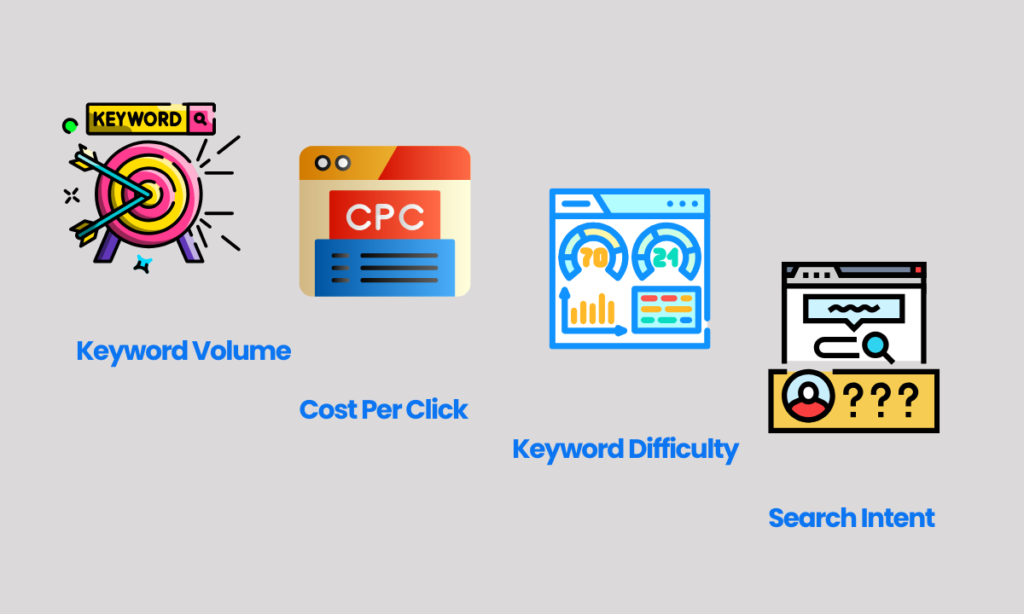
To prioritize keywords, evaluate these metrics:
- Search Volume: Indicates how many times a keyword is searched monthly.
- High-volume keywords bring traffic but may be competitive.
- Keyword Difficulty (KD): Measures how hard it is to rank for a keyword.
- Lower KD is ideal for smaller or newer websites.
- Cost Per Click (CPC): Shows the cost of paid ads for the keyword, reflecting its commercial value.
- For example, “Buy running shoes online” may have a high CPC due to high purchase intent.
- Search Intent: Understand whether users seek information, navigation, or transactions.
- Example: “How to bake a cake” (Informational) vs. “Buy chocolate cake near me” (Transactional).
Analyzing these metrics ensures you choose keywords that align with your goals and audience needs.
Competitor Keyword Analysis
Competitor analysis involves studying the keywords your rivals are targeting to find opportunities or gaps.
How to Perform Competitor Keyword Analysis:
- Identify your top competitors in search results.
- Use tools like SEMrush or Ahrefs to analyze their top-performing keywords.
- Look for:
- High-ranking keywords you can also target.
- Keywords they rank for but aren’t utilizing effectively.
Example: If a competitor ranks for “budget smartphones” but lacks content on “budget smartphones under $300,” you can create content targeting that gap.
Building a Keyword List for Your Niche
A keyword list serves as your roadmap for SEO and content creation.
Steps to Build Your List:
- Combine your seed keywords with related terms from research tools.
- Segment keywords into categories based on intent, topic, or priority.
- Example: “Fitness equipment” can branch into “home gym setups” or “weight training for beginners.”
- Balance short-tail, long-tail, and local keywords for a diversified strategy.
- Prioritize based on search volume, competition, and your business goals.
- Update and refine your list periodically to reflect trends and performance data.
SEO Content Writing Based on Keyword Analysis
SEO content writing is the art of creating engaging, valuable, and optimized content that resonates with your target audience and ranks well in search engines. When driven by keyword analysis, this process ensures that your content aligns with user intent, targets relevant search terms, and attracts organic traffic. Here’s a detailed guide on how to write effective SEO content using keyword analysis.

Why Keyword Analysis is Essential for SEO Content Writing
- Identifies User Intent: Helps understand what your audience is searching for.
- Improves Relevance: Ensures your content matches search queries.
- Boosts Rankings: Targets keywords with high search volume and manageable competition.
- Drives Organic Traffic: Brings the right audience to your website.
Steps to Write SEO Content Based on Keyword Analysis
1. Start with Comprehensive Keyword Research
- Use tools like Google Keyword Planner, Ahrefs, SEMrush, or Ubersuggest to identify:
- Primary Keywords: The main keyword you want to rank for (e.g., “SEO content writing”).
- Secondary Keywords: Related terms that support the main topic (e.g., “content optimization,” “keyword-driven articles”).
- Long-Tail Keywords: Specific phrases with lower competition (e.g., “how to write SEO-friendly blogs”).
- Group your keywords into clusters based on intent, such as informational, transactional, or navigational.
2. Understand Search Intent
Before writing, ask:
- Informational Intent: Are users looking for answers or tutorials?
- Transactional Intent: Are they ready to make a purchase?
- Navigational Intent: Are they searching for a specific website or page?
Example:
For a keyword like “best SEO tools,” users likely want a comparison or listicle.
3. Plan Your Content Structure
- Choose the Right Content Type: Blog posts, listicles, how-to guides, product pages, etc.
- Outline Your Content: Use keyword clusters to create subheadings and organize sections.
- Optimize for Readability: Use headings (H1, H2, H3), bullet points, and short paragraphs.
4. Optimize Keywords Strategically
Incorporate your keywords naturally into these elements:
- Title Tag: Include the primary keyword (e.g., “SEO Content Writing: A Complete Guide”).
- Meta Description: Use a compelling summary with the primary keyword.
- Headings and Subheadings: Optimize H1 and H2 tags with primary or secondary keywords.
- First 100 Words: Mention the primary keyword early in the introduction.
- Body Text: Distribute keywords evenly but avoid overstuffing.
- URL Structure: Keep it short and include the primary keyword (e.g., /seo-content-writing-tips).
- Image Alt Text: Describe images with relevant keywords.
Also Read: Building Local SEO Outside Your Core Location: A Comprehensive Guide
5. Focus on Quality and Value
Content that ranks well isn’t just optimized for search engines—it provides value to readers.
- Answer Questions: Address common queries related to the keyword.
- Provide Solutions: Offer actionable insights, examples, or tips.
- Be Original: Avoid duplicate content; create unique, research-backed material.
6. Incorporate LSI Keywords
Latent Semantic Indexing (LSI) keywords are terms related to your main keyword. They help search engines understand your content better.
Example for “SEO content writing”:
- “Content optimization strategies”
- “Keyword density”
- “SEO-friendly blog posts”
7. Use Internal and External Links
- Internal Links: Guide readers to related pages on your site (e.g., linking to an article on “how to do keyword research”).
- External Links: Cite authoritative sources to build credibility.
8. Optimize for User Experience (UX)
- Mobile-Friendly Design: Ensure your content is easy to read on mobile devices.
- Page Speed: Optimize images and code for fast loading times.
- Visual Elements: Use images, videos, and infographics to enhance engagement.
9. Monitor and Update Content Performance
- Use tools like Google Analytics and Google Search Console to track:
- Keyword rankings.
- Click-through rates (CTR).
- Bounce rates.
- Engagement metrics.
- Update outdated content to maintain relevance and improve rankings.
Best Practices for SEO Content Writing
- Write for Humans, Not Just Search Engines: Prioritize readability and value.
- Avoid Keyword Stuffing: Overuse of keywords can hurt rankings.
- Maintain Consistency: Post regularly to build authority.
- Optimize for Featured Snippets: Answer questions concisely in bullet points or numbered lists.
Conclusion
Keyword analysis serves as the foundation for successful SEO content writing. By identifying the right keywords, understanding user intent, and optimizing content effectively, you can significantly enhance your website’s visibility, drive organic traffic, and improve user engagement.
The process begins with thorough keyword research, utilizing tools to uncover primary, secondary, and long-tail keywords. This step ensures that your content aligns with what your target audience is searching for. Crafting a well-structured content strategy, enriched with natural keyword placement, is crucial to achieving better search engine rankings while maintaining readability and user satisfaction.
Incorporating related LSI keywords, leveraging internal and external links, and focusing on user experience further strengthens your content’s value. Regular monitoring and updates ensure your content remains relevant and continues to perform well over time.
Ultimately, successful SEO content writing isn’t just about ranking, it’s about providing genuine value to your audience. By mastering keyword analysis and following SEO best practices, you can create content that resonates with readers and meets your business goals.
Explore Our More Blogs:
Domain Rating vs. Domain Authority